The Black Ocean Was Never the Threat: What Fear Reveals About Real Safety
IDENTITY & MEANING, PRESSURE PERFORMANCE
13 min read
The Black Ocean Was Never the Threat: What Fear Reveals About Real Safety
Insights on cognitive patterns, pressure responses, identity and execution.
FIELD NOTES
Insights. Tools. Invitations
Subscribe to receive field notes, frameworks and studio updates.
The Moment You Leave Yourself
When we only feel safe when we are far from the unsafe, that sense of safety is conditional on external proximity rather than internal structure.
It is convincing. But if you stay with it a moment longer, you realise that it is just a system that has moved far enough away from the threat to feel safe.
It shows up most clearly in how quickly we explain ourselves. How urgently we correct a misunderstanding. How subtly we try to manage someone’s perception before disappointment has time to land.
Because what is that, really?
That is creating distance from the threat.
Distance from being misread, judged or sitting in the discomfort of someone not getting you or seeing you in your best light.
There is another kind of safety. It does not come from being understood or staying ahead of the moment. It comes from capacity and presence. The ability to remain in your body even when someone is disappointed in you, even when the story about you is wrong, even when nothing in you gets to correct it.
You can care, and no longer need to escape it to be okay.
Experiment: When you walk down the street and see someone look at you, what is the first thing you think? If you start to wonder how they perceive you, fix your appearance or feel anything other than a neutral observation, catch and log it. That is the moment you leave your body. You do that by trying to be in someone else's eyes watching yourself. This is the moment you are no longer experiencing yourself. You are monitoring yourself. Our processing bandwidth shifts to impression management to feel safe, instead of task execution, enjoyment or flow. That shift alone is enough to distort how you think, feel, and act.
The Dream as Data
Recently, I had a dream.
Two men were chasing me. They intended to kill me. I did not know why.
I ran.
There was no hesitation, no philosophical inquiry into the nature of danger. The body knew before I did.
Run.
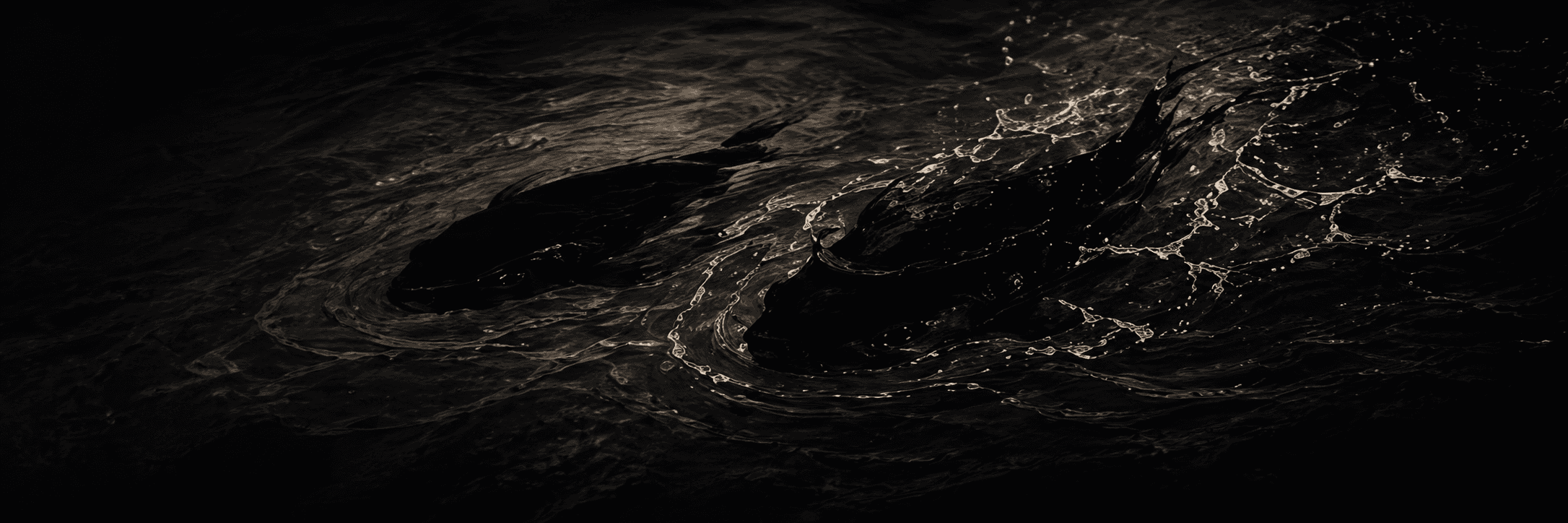
I outran them, though fear pulsed through me like a second bloodstream. Ahead of me was a black ocean. Dark, rough, unknowable. Two hundred metres away, a concrete platform.
There was a moment, brief but real, where I considered the sharks.
Then I jumped.
And something unexpected occurred.
I could swim.
Not only swim, but swim without fear.
The ocean, which should have been terror, became merely a medium. Movement became fluid, almost clean.
I reached the platform. They followed.
So I swam again.
Later, their bodies appeared. Transformed. No longer men, but something else entirely. Black, sleek, monstrous fish. Dead.
Dreams do not explain.
They reveal.
And what this dream revealed is not that I am being chased.
It revealed how I have learned to be safe.
The First Illusion: Safety as Distance
There is a part of the psyche that does not concern itself with truth, only survival.
It learned early:
Move quickly
Anticipate
Do not wait to confirm danger
Do not rely
Do not be still
To this part, safety is simple:
Safety = how far you are from threat.
It does not ask whether the threat is real, current, or remembered.
It does not ask whether you are capable.
It asks only: Are you far enough away yet?
This part is not primitive in the way people assume. It is sophisticated. It calculates faster than conscious thought.
And it has one fundamental belief:
Stillness is dangerous.
This belief does not stay contained. It propagates, rapidly and automatically, into decisions, reactions, and interpretations.
Think of it as a multi-dimensional storm system in the background of your mind, with lightning strikes firing at the speed of thought into both large and insignificant moments alike. Each strike lands before conscious thought has time to engage.
The Second Reality: Safety as Capacity
There is another kind of safety, far less familiar, and far more confronting.
It does not come from distance.
It comes from within.
It is not the absence of threat.
It is the presence of capacity.
Capacity to:
feel without collapsing
assess without panicking
remain without escaping
move without urgency
This safety does not say, “Nothing bad will happen.”
It says:
“If something does happen, I can meet it.”
And this is where the psyche hesitates.
Because to live from capacity is to relinquish the constant movement that once guaranteed survival. It is to risk stillness.
Unfortunately, it is also how we see competitive advantage because we confuse stillness for stuckness or lag. In high performers, stillness can become an edge when you see it as:
active non-reaction
It’s the moment where:
signal separates from noise
urgency loses authority
decisions stop being emotionally inflated
That is not passive.
That is control at a higher layer of the system.
The System Beneath the Narrative
It is patterned.
And observable.
And embodied.
Dreams bypass the polite narratives of the waking mind. They show you the architecture beneath.
In my dream, the running did not stop.
I still ran. There is more work to be done when threat is manifested in the dream space.
But I also chose.
I assessed the ocean. I weighed the sharks. I entered anyway.
And once inside, something profound occurred:
The environment did not change.
My relationship to it did.
The black ocean remained black.
But I was no longer afraid of it, and I felt pleasantly surprised I was thriving in it.
Fears melted away as I embraced my capacity to adapt and continue.
Distance Vs. Capacity: How Do You Tell the Difference?
This is the question that matters.
Not philosophically.
Practically.
How do you know whether you are safe because you have escaped… or because you can handle what remains?
The answer is not in your thoughts.
It is in your body.
When safety is distance from threat:
There is urgency, even in relief
Stillness feels like exposure
You scan, even when nothing is wrong
Action feels necessary, not chosen
You feel safe until something happens
There is always a condition:
“I am safe… as long as…”
You are operating from distance when:
you respond before you’ve processed
you correct before misunderstanding lands
you optimise before you decide
When safety is capacity:
The body slows without effort
You can remain, even with uncertainty
You do not rush to resolve
Movement feels optional
You trust your ability to respond, not predict
There is no condition.
Only a quiet, almost unsettling (at first) recognition:
“I can handle what comes.”
You are operating from capacity when:
you can pause without losing clarity
you don’t rush to resolve discomfort
you allow perception to exist without managing it
Where It Shows Up in Real Life
In waking life, this distinction reveals itself in subtle ways.
You will see it in:
how quickly you respond to discomfort
whether you over-adjust to external signals
how you relate to uncertainty, delay, or ambiguity
whether you seek resolution or can tolerate unfolding
The person operating from distance will optimise endlessly.
The person operating from capacity will choose deliberately.
From the outside, they may look similar.
From the inside, they are entirely different lives.
Experiment: Preloading ease instead of freeze
Think of a time you felt stressed about something, got through it, and realised it wasn’t as hard as you imagined. That feeling of “this is manageable” usually comes after the task? This experiment is about bringing it before.
Before starting something that usually triggers hesitation or freeze, pause and remind yourself:
“There’s a version of this where I finish and realise it was simple.”
Then begin from that place of ease, not urgency, proving to your system that performance doesn’t require pressure, and that clarity can replace overwhelm.
Insight: There is a form of stress that does not contract you, rush you, or distort your thinking. This form of stress organises you, holds you and is useful.
This is referred to as eustress.
Distress is when pressure overwhelms capacity.
Eustress is when pressure activates you without destabilising you.
Why This Is Hard to Change
Here is the quiet tragedy in safety in distance.
The self does not trust capacity.
It cannot.
Because it was not formed in an environment where capacity was sufficient.
It was formed where:
speed was necessary
anticipation was protective
stillness was punished
dependence was dangerous
So when you begin to develop capacity, something inside you resists.
It whispers:
“Don’t stop. Don’t test it. Don’t find out.”
And Yet…
There comes a moment—subtle, almost easy to miss—where something shifts.
You notice that you can move without exhausting yourself.
That you can respond without urgency.
That you can remain present without bracing.
You notice, perhaps with mild surprise:
“I am not as fragile as I once believed.”
This is not confidence.
It is something much more structural.
The Structural Shift
You do not become safe by eliminating threat.
Nor by perfecting your ability to escape it.
You become safe when:
The presence of non-existential threat no longer shocks your internal state.
When running is no longer compulsory.
When stillness is no longer synonymous with danger.
When the ocean remains black… and you enter anyway.
And perhaps the most disorienting part of all:
You realise that the fear that chased you;
the vulnerability, disappointment, criticism you spent a lifetime outrunning were never only outside of you.
And when they finally dissolve, transform, or die in the language of dreams,
what remains is not victory.
But something far more confronting.
Choice.
And that's the next part of the work.