
When Certainty Becomes Truth
AMBITION & LIFESTYLE
8 min read
When Certainty Becomes Truth
Insights on cognitive patterns, pressure responses, identity and execution.
FIELD NOTES
Insights. Tools. Invitations
Subscribe to receive field notes, frameworks and studio updates.
“Existential Truth”
“Children are a psychobiological imperative,” my therapist announced.
What struck me wasn’t the statement, but the certainty behind it.
It wasn’t presented as a perspective. It was presented as truth. And once something is framed that way, it becomes harder to question without feeling like you’re resisting reality itself.
Reproduction and evolution are often framed as necessary for a normal, happy life. But if we are to follow Nature as a roadmap for happiness, why do we disregard so much of what is natural?
The question isn’t whether the statement is right or wrong.
It’s what happens when something like that is delivered as unquestionable.
Therapy and Social Permission
With growing awareness of mental health, it has become a sign of maturity to seek therapy when one needs support.
Starting sentences with “My therapist says…” now carries a kind of social permission. It signals legitimacy. Thoughtfulness. Self-awareness.
And the role of the therapist is a responsible one.
The relationship, although transactional, often becomes one of the few places where people feel seen and understood in an increasingly disconnected world.
But that relationship carries weight.
Most people don’t go to therapy when things are neutral. They go when something feels off. When they’re dissatisfied. When they’re trying to resolve internal or external conflict.
That creates a particular dynamic.
If you’re seeking clarity, and the person you trust speaks with certainty, it’s easy to adopt that certainty as your own.
A good therapist doesn’t give you answers.
They challenge your assumptions.
They create uncertainty around beliefs that don’t serve you.
They help you examine the structure of your thinking so you can make decisions more deliberately.
If you depend on your therapist for answers or certainty, the relationship has shifted.
Because the moment a belief is adopted without examination, it stops being supportive, and starts to feel structural.
The Elusive Nature of Truth
The closest thing to a universal truth is:
"It is what it is"
— possibly because it is the broadest, most frustrating and least interpretive way to acknowledge and accept anything that happens.
However, it doesn't mean that there is nothing more to examine here. It acknowledges what is there, without adding meaning. But it also stops there. It becomes limiting because acknowledging reality is not the same as understanding it.
Cognitive dissonance also plays a role in holding our reality together. We cannot eliminate it entirely without becoming paralysed. We operate inside a system that allows for contradiction, interpretation, and partial understanding. Our world is a contextual paradox of unlimited possibilities. The pursuit of fixed, universal life truths starts to break down under that complexity.
I once thought science might offer something closer to certainty. But even science provides provisional truths — patterns that hold, until they don’t.
So the question becomes: What do you build your life on, if certainty is always incomplete?
Where Meaning Enters
Truth, even when it exists, doesn’t resolve decisions.
It describes. It doesn’t direct.
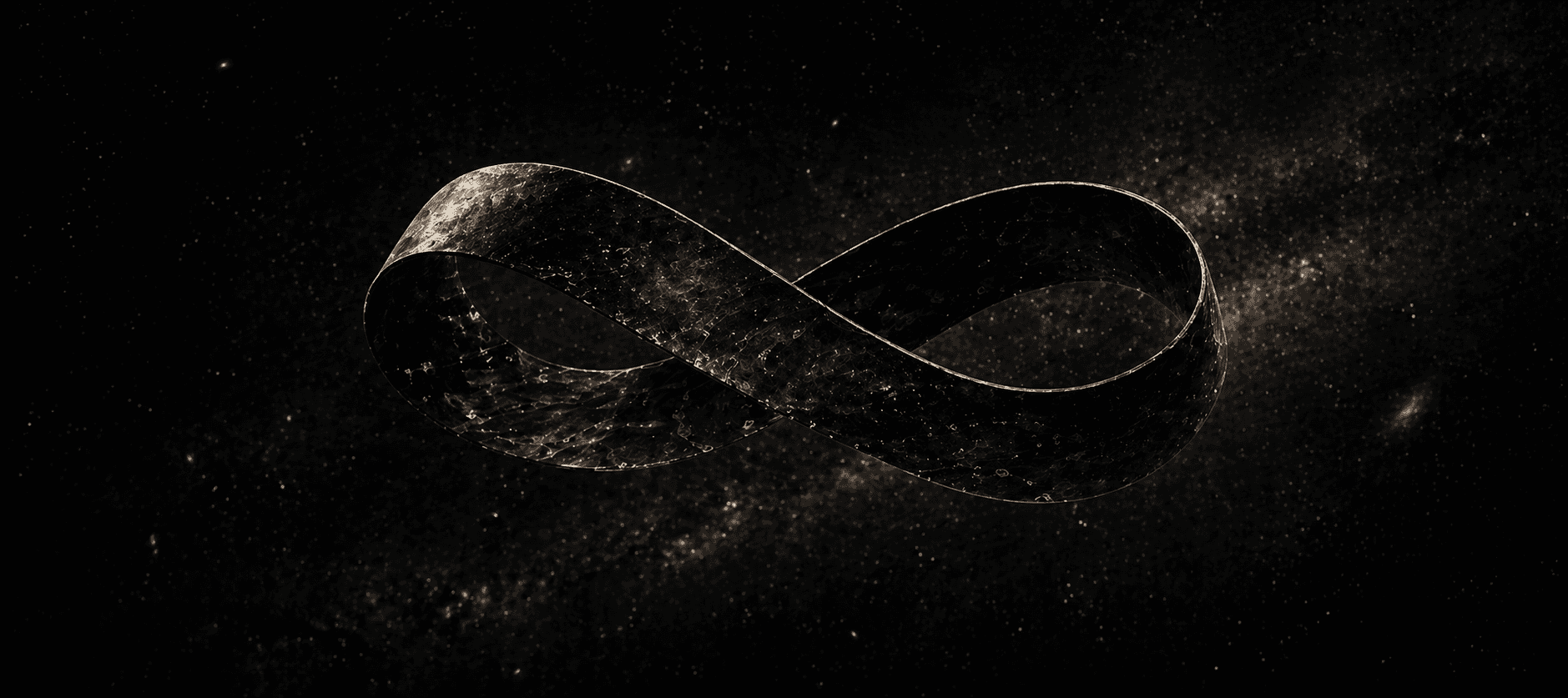
At some point, every thread of reasoning folds back on its meaning-maker, creating a kind of Möbius strip where explanation loops into interpretation. The problem is that we often adopt other people’s truths without examining what they do to our lives. When a belief is presented with certainty, it can close the space for alternative interpretations, and once that space closes, decisions start to feel inevitable.
Finding Your Own Truth
So rather than trying to find a universal truth that withstands all criticism, it becomes more useful to examine what is shaping your own.
Your truth is more relevant to how you actually live and decide.
“It is what it is” is where most people stop.
“It is what we make it” is where decisions begin.
Truth may describe reality, but meaning determines what you do with it.